

Market Resilience Amid Geopolitical Volatility
Our Blog
Market Resilience Amid Geopolitical Volatility
The Current Landscape
Geopolitical shocks rarely come with advance notice, and the recent escalation of conflict involving the United States, Israel, and Iran is no exception. Over the past several days, markets around the world have been digesting a rapidly evolving situation, including the reported death of Iran’s Supreme Leader following joint U.S.–Israeli strikes, subsequent retaliatory actions, and disruptions in key global energy and shipping routes.
These events understandably lead to heightened uncertainty. However, history reminds us that while markets often react abruptly in the short term, they tend to stabilize as conditions become clearer.
Regional Impact and Energy Markets
The conflict intensified following major strikes on Iranian targets, triggering a wave of retaliatory attacks across the Middle East. Of particular concern to global markets is the reported threat to the Strait of Hormuz, a vital waterway for roughly 20% of the world’s oil supply. This has resulted in:
- Energy Volatility: A significant spike in crude prices as supply chain fears mount.
- Travel Disruptions: Widespread flight cancellations and increased shipping insurance costs.
- Global Tension: A general “risk-off” sentiment across European and Asian markets.
Understanding the “Risk-Off” Reaction
In the immediate aftermath of such shocks, global markets typically follow a predictable pattern:
- Equities: U.S. and international stocks often open lower as traders reassess risk.
- Safe Havens: Assets like gold and U.S. Treasuries initially rise as investors seek stability.
- Sector Divergence: Energy and defense stocks often move higher, reflecting the immediate demands of the conflict.
This volatility is a hallmark of “uncertainty.” Markets dislike a vacuum of information. The early days of any military conflict generate rapid repricing as investors attempt to gauge both the severity and the potential duration of the event.
Why This Reaction is Often Temporary
While day-to-day swings feel unsettling, geopolitical events historically exert their strongest influence in the short term. Once “knowns” replace “unknowns”—whether through diplomatic traction or stabilized energy forecasts—markets tend to regain equilibrium.
It is worth noting that while commodities and defense stocks may spike initially, extreme moves often fade as the conflict reaches a plateau. Similarly, early analysis suggests that unless an engagement becomes significantly more prolonged, the broader impact on the U.S. economy remains limited.
In fact, we have already seen instances where the S&P 500 opened sharply lower only to finish the day near flat as investors “bought the dip.” This serves as a powerful reminder: the market’s recovery often begins while the headlines are still at their loudest.
A Perspective for long-term investors
For the long-term investor, the most important message is this: Volatility is a feature of the market, not a bug. Our financial systems have navigated wars, recessions, and global upheavals before. While each event feels unprecedented in the moment, the long-term trajectory has remained resilient.
To maintain perspective during this time:
- Filter the Noise: Avoid reacting emotionally to 24-hour news cycles.
- Stick to the Blueprint: Your portfolio was built to weather periods of turbulence exactly like this.
- Think in Years, Not Days: Disciplined investing is rewarded by staying the course when others are tempted to exit.
As a great reference, if you click either of the images below, you will see a chart highlighting all the “Crises and Events” since 1970 and 2008, and how the S&P has weathered the storms.
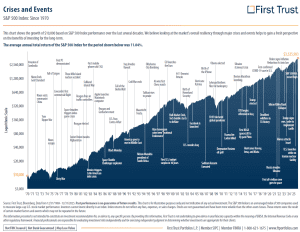
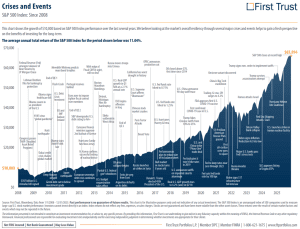
As always, we are monitoring the situation closely. We are here to help you navigate this uncertainty with clarity and confidence.
If you have questions about how this period of volatility affects your specific strategy, please reach out. These conversations are exactly why we are here.
We Are Your
Partners for
Years to Come
Harvest Wealth Partners is committed to helping our clients work towards a successful future. We believe in your potential to understand the financial options that can lead you to your goals. Call us today to partner with our team. We look forward to continuing our mission for years to come.













Contact Us Today
We Are Your Partners for Years to ComeHarvest Wealth Partners is committed to helping our clients work towards a
successful future. We believe in your potential to understand the financial options that
can lead you to your goals. Call us today to partner with our team. We look forward to
continuing our mission for years to come.
Contact Us
Fill out our quick form to connect with us.

The content is developed from sources believed to be providing accurate information. The information in this material is not intended as ERISA, tax, legal or investment advice. Please consult legal or tax professionals for specific information regarding your individual situation. Some of this material was developed and produced by NUVEW to provide information on a topic that may be of interest. NUVEW is not affiliated with the named representative or SEC-registered investment advisory firm. The opinions expressed and material provided are for general information, and should not be considered a solicitation for the purchase or sale of any security. By providing contact information, users acknowledge and give explicit consent to be contacted via the methods of communication provided, including SMS. Message and data rates may apply. Message frequency may vary. Reply STOP to opt out.
Investment advice offered through Private Advisor Group, a registered investment advisor. Harvest Wealth Partners and Private Advisor Group are separate entities. Investing in securities involves risk, and there is always the potential of losing money. Past performance does not guarantee future results. Asset allocation, rebalancing, and diversification do not guarantee against risk in broadly declining markets. Private Advisor Group offers investment advice in every state, the District of Columbia, Puerto Rico, and the U.S. Virgin Islands.
NUVEW | Copyright 2026 All Rights Reserved | Harvest Wealth Partners | Accessibility Notice | Privacy statement | Private Advisor Group Form CRS